Category

Bookkeeping

How to Calculate Conversion Cost Formula Example

By | Bookkeeping | No Comments

conversion cost formula

In this section, we will delve into the concept of Conversion Cost Variance and explore how it can be measured and analyzed. Conversion costs refer to the expenses incurred during the transformation of raw materials into finished goods. Conversion cost, as the name implies, is the total cost that a manufacturing entity incurs to transform or convert its direct materials into salable or finished product. Typically, it is equal to the sum of entity’s total direct labor cost and total manufacturing overhead cost. In this section, we will delve into the concept of the conversion cost ratio and its significance in cost accounting and management. The conversion cost ratio measures the proportion of conversion costs to the total manufacturing cost, providing valuable insights into the efficiency and cost-effectiveness of the production process.

Conversion Costs

  • Remember, the pursuit of cost-effective conversion doesn’t compromise product excellence—it ensures sustainable growth and customer satisfaction.
  • To speed up the production process, they rented an assembly plant for ₹1,50,000/Month.
  • Analyzing conversion cost variance involves investigating the reasons behind the variance and identifying the specific cost components that contributed to it.
  • The raw materials required for the product are transformed through specific processes, and finally, products are developed for sale in the market.
  • To plan the production budget, the conversion cost per unit can be multiplied by the expected number of units to be produced in the future.

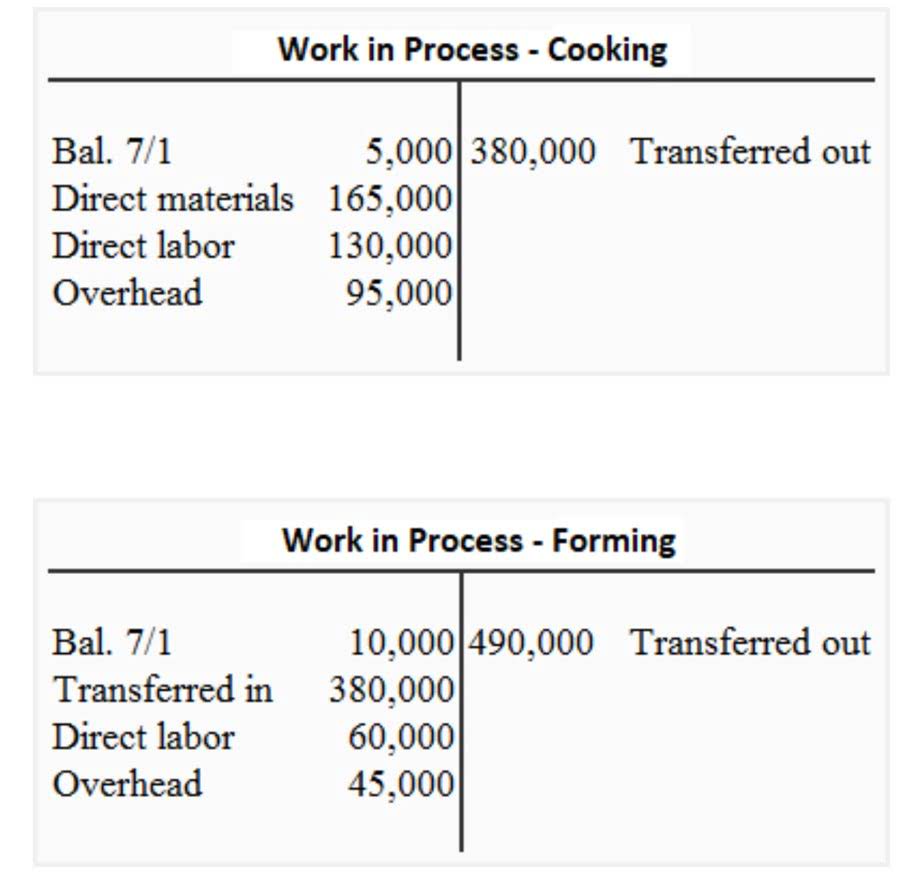
In summary, understanding the components of conversion cost empowers businesses to optimize their production processes, manage Insurance Accounting expenses effectively, and make informed decisions. By considering direct labor, direct materials, overhead, depreciation, quality control, and the conversion cost formula, organizations can enhance their cost control strategies and drive profitability. Remember that these components interact dynamically, and a holistic approach is essential for accurate conversion cost analysis. The 1,200 ending work in process units are only 35% complete with regard to conversion costs and represent 420 (1,200 × 35%) equivalent units.
conversion cost formula

Difference between Conversion Cost and Prime Cost

For the final assembly of cars, they rented heavy-duty machinery for ₹80,000 and paid ₹50,000 as the electricity bill. If it is not, such as just one or two conversions from 1,000 clicks, consider pausing the keyword. You see which of your campaigns have the lowest cost per conversion, preferably compared to high values for those conversions, and focus your efforts and budget on them. Remember that you can define conversion however you want, such as the number of sales and number of operating leverage dol formula + calculator signups for your email list. The following are some of the most commonly used conversion metrics when assessing conversion cost. Each has its own example of how you would net sales assess conversions with your given definition for the conversions.
conversion cost formula

Unit Converter

conversion cost formula

The total of direct labor costs and manufacturing overhead costs gives you the conversion cost for a specific period (e.g., a month or a quarter). Rather, such expenses are considered as indirect labor which goes to the entity’s total manufacturing overhead cost (discussed later in this article). Examples of such expenses include the salaries of production supervisor and factory watchman etc. Conversion Cost Variance is a crucial metric for cost accounting and management.

How to Use the Conversion Cost Information for Decision Making and Management?

Conversion costs are calculated in order to know the cost per unit, which assists the company in deciding a price for the product. A periodical review of the firm’s prime cost is crucial to ensure the efficiency of its manufacturing process. The computational responsibility lies with the factory manager who collects the relevant data, calculates the prime cost figure for the period and reports the same to operations manager for review. This indicates that 25% of the total manufacturing cost is attributed to conversion costs. A positive variance indicates that the actual conversion costs exceeded the budgeted costs, while a negative variance suggests that the actual costs were lower than the budgeted costs.

  • The inventory valuation is the cost of the goods that are not sold and remain in the ending inventory, and it is reported as a current asset in the balance sheet.
  • Some common examples are insurance, building maintenance, machine breakup, and taxes on equipment or machining.
  • In the Peep-making process, the direct materials of sugar, corn syrup, gelatin, color, and packaging materials are added at the beginning of steps 1, 2, and 5.
  • Compare the conversion cost per unit with the previous periods, the industry average, or the target cost to evaluate the performance and efficiency of the production process.
  • As can be seen, labor is the cost that mainly determines the transformation or conversion process, then from here on there must be costs of a similar nature or of a similar impact.

Understanding Direct Conversion Costs

conversion cost formula

Direct labor costs are the wages and benefits paid to the workers who directly work on the product. Manufacturing overhead costs are the indirect costs that support the conversion cost formula production process, such as utilities, rent, depreciation, maintenance, etc. These costs include wages, salaries, and benefits paid to workers directly involved in the production process. For instance, assembly line workers, machine operators, and quality control personnel contribute to the conversion process. Their time and expertise are essential for turning raw materials into usable products.

  • Assume that there was no work in process inventory at the beginning and at the end of the accounting period.
  • These examples illustrate how the conversion cost formula and per unit cost can be applied to different scenarios.
  • The following are some of the most commonly used conversion metrics when assessing conversion cost.
  • They offer insights into the efficiency of manufacturing operations and potential areas for cost reduction.
  • Conversion costs are calculated in order to know the cost per unit, which assists the company in deciding a price for the product.
  • Thus, each cost concept provides a somewhat different view of the costs incurred to create products.

conversion cost formula

This means that the toy company spends $10 on direct labor and manufacturing overhead for each doll it produces. How to use conversion cost for cost accounting purposes, such as assigning costs to products, inventory valuation, and variance analysis. Manufacturing cost is the cost that company spends to support the production process but they cannot allocate to each product. They are the indirect cost that incurs to support the manufacturing, but it is very challenging to apply the cost to each production unit. In summary, managing and reducing conversion costs requires a holistic approach, combining process optimization, strategic partnerships, employee engagement, and technological advancements.


Forecasts vs Target Setting: Importance of Understanding and Managing the Difference

By | Bookkeeping | No Comments

budget vs forecast vs projection

As mentioned, budgets are created for a fixed period of time (usually one year). A forecast is a financial snapshot of the future as it is best understood today. When creating a forecast, teams must examine possible financial outcomes based on the most up-to-date drivers and assumptions. The result is a view of how the business is trending so that the leaders can determine whether or not adjustments should be made to the existing budgets or plans.

budget vs forecast vs projection

Budgeting vs. Forecasting: 4 Key Differences

A budget is a financial plan for spending based on estimates of expenses and income over a specific period (usually a year). The purpose of a budget is to set and track financial goals for the business. It provides a framework for businesses to make strategic decisions on allocating resources and prioritizing expenses. Financial decisions rely on budgets, forecasts, and projections to allocate Certified Public Accountant resources, set goals, and assess risks. A budget sets targets, a forecast adapts to changes, and projections explore possibilities. When you analyze data, adjust plans, and model scenarios, you contribute insights that business leaders count on.

Timeframe

Rather than relying solely on spreadsheets, organisations should consider purpose-built forecasting tools that integrate with other business systems and apply statistical methods to improve prediction quality. Perhaps most importantly, forecasts should be treated as decision-support tools rather than definitive predictions, with an understanding that their primary value lies in helping businesses prepare for an uncertain future. The budgeting process forces conversations about priorities and trade-offs, making it valuable for organisations that need to coordinate activities across multiple departments. It creates a financial roadmap that connects operational activities to strategic objectives, ensuring all parts of the business move in the same direction. For companies implementing major initiatives or transformations, budgets provide the financial structure needed to track progress and measure success against predetermined targets.

The Cash Flow Forecasting Guide for Startups: Pitfalls & How To Avoid Them

budget vs forecast vs projection

In contrast, forecasting offers a forward-looking view, anticipating financial outcomes based on historical data, market trends, and operational insights. The analysis gives you essential insights into performance gaps, making it easier to identify and make the strategic adjustments needed for success. For organisations looking to enhance their financial planning capabilities, Fyorin offers comprehensive treasury management solutions that support both budgeting and forecasting processes. With robust data integration, automated workflows, and powerful analysis tools, Fyorin helps finance teams spend less time on administrative tasks and more time on strategic financial planning that drives business success.

budget vs forecast vs projection

What’s the difference between budget vs forecast vs plan?

Imagine a company budgets $10 million for materials, expecting a $5 million profit. However, three months later, supply chain issues drove material costs up by 30%. Both of those movies, but The Lion King in particular, went on to be huge successes, grossing $569 million and $1.657 billion respectively, making them some of the bigger successes of Disney’s recent live-action offerings. Revenues increase over the next few years, largely because certain provisions of the 2017 tax act are scheduled to expire. Thereafter, they generally rise, reaching 19.3 percent of GDP in 2055, as growth in real income—that is, income adjusted to remove the effects of changes in prices—boosts receipts from the individual income tax. When teams have clarity into the work getting done, there’s no telling how much more they can accomplish in the same amount of time.

  • The algorithmic comparisons and automated data mining capabilities greatly reduce manual effort while maintaining precision.
  • This is the time to make tactical changes that will benefit your company long-term.
  • Budgets are built around goals and include granular detail around planned revenue and expenses.
  • When creating your forecast, rather than only looking at your primary products or services, take a holistic approach and include the entire company.
  • It helps businesses predict cash shortages, plan expenses, and ensure they have liquidity to cover operating costs.

How to Do a Cash Flow Projection

budget vs forecast vs projection

We’ve made a detailed list of the top scenario-planning software solutions (along with other useful articles) that you might want to check out. Use Productive to Quickly compare forecasted deal values with current sales pipeline. A telecommunications company may take a top-down approach, starting with the total industry market size and then estimating its market penetration. Maximise your tax return by understanding how to claim depreciation on eligible assets. Generally, you want this fund to cover at least 2 months of operating costs. In other words, if all revenue stopped tomorrow, you’d be able to continue as normal for 2 months before experiencing interruptions.

Driver-based budgeting ties financial plans to key business drivers, making budgets more dynamic and aligned with actual business activities. Technology solutions have also streamlined the budgeting process, reducing the administrative burden budget vs forecast vs projection while improving accuracy and collaboration. While many business owners have to focus on managing the day-to-day, planning for the future is key to managing cash flow and finding growth opportunities.

Marketing Campaign Budget

In contrast, target setting is an aspirational process that defines where management intends to steer the business — indicating the management team’s desire, capability and intent to improve upon current business results. Forecasts provide management with a realistic outlook on financial performance, cash needs, workforce and supply needs and any gaps in desired performance so that they may develop countermeasures to bridge those gaps. Earning CFI’s industry-recognized Financial Modeling & Valuation Analyst (FMVA®) Certification equips you with practical skills to stand out in today’s competitive market. Through structured courses, hands-on case studies, and guided practice, you’ll develop the expertise to create sophisticated forecast models that drive business decisions. Experienced analysts often combine different methods for more robust forecasts. A common approach is validating bottom-up operational forecasts against top-down market analysis to capture both company-specific drivers and market realities.

budget vs forecast vs projection

Both budgets and forecasts empower companies to navigate change effectively, capitalize on opportunities, and create revenue growth. The more actively a company uses their budgets and forecasts, the more financially Food Truck Accounting healthy it will be long-term. Budgets are most strategically impactful when they’re actively used as goal-setting frameworks and performance assessment tools. When employees and managers use budgets to understand financial goals and limitations, they can align their efforts accordingly.